
Understanding the July Visa Bulletin for EB-5 Investors
The July Visa Bulletin published by the U.S. State Department is a critical monthly update for EB-5 investors who want to understand when an approved EB-5 petition can actually convert into a U.S. green card. The July Visa Bulletin is much more than a technical chart; it is the primary tool the U.S. State Department uses to manage worldwide and per‑country limits on immigrant visas. For EB-5 investors and their families, it shows whether your priority date is current, whether there is a backlog for your country, and how the EB-5 reserved (set‑aside) categories compare to traditional, unreserved EB-5 numbers. Because immigrant visa demand shifts throughout the year, each Visa Bulletin provides a snapshot of where the EB-5 queues stand and how quickly different groups of investors can expect to move forward.
Under U.S. immigration law, employment-based immigrant visas, including EB-5, are subject to strict annual numerical limits. The July Visa Bulletin released by the U.S. State Department implements those limits in real time, adjusting cut-off dates as demand rises or falls. Even if an EB-5 investor has an approved I‑526 or I‑526E petition, a green card cannot be issued until a visa number is available under the Visa Bulletin. That is why EB-5 investors, project sponsors, and advisors watch each new Visa Bulletin very closely—it directly affects planning for consular processing, adjustment of status, and family timelines such as children approaching age 21. At Bedrock Group in Dallas–Fort Worth, we treat every monthly Visa Bulletin, including this July Visa Bulletin, as an essential planning document for our EB-5 clients.
Key Visa Bulletin Terms EB-5 Investors Must Know
To get real value from the July Visa Bulletin, EB-5 investors need to understand the main terms and how they interact. The U.S. State Department structures the Visa Bulletin around “preference categories,” “priority dates,” “Final Action Dates,” and “Dates for Filing,” along with country‑by‑country limits.
Employment-Based Categories and EB-5 Structure
Employment-based green cards are grouped from EB‑1 to EB‑5. EB‑5 is the fifth employment-based preference category, intended for immigrant investors who make a qualifying investment in a U.S. commercial enterprise and create at least 10 full‑time jobs. The July Visa Bulletin, like all monthly bulletins, has a dedicated line for “Employment‑Based Fifth Preference (EB‑5).”
Since the EB‑5 Reform and Integrity Act of 2022, EB‑5 is further divided into:
- Unreserved visas (the traditional EB‑5 pool, including most standard urban projects).
- Reserved (set‑aside) visas, designated for:
- Rural projects
- High unemployment area (HUA) projects
- Infrastructure projects
The July Visa Bulletin from the U.S. State Department reflects this structure, with separate rows for “Unreserved” and the three “Set‑Asides.” For EB-5 investors, the distinction is now crucial: unreserved numbers tend to face more pressure, while reserved categories often remain current.
Priority Date
The priority date for EB-5 investors is generally the date USCIS receives your Form I‑526 (legacy) or Form I‑526E (regional center). This date fixes your place in line within the EB‑5 category and your country of chargeability (usually your country of birth). In the July Visa Bulletin, the U.S. State Department compares national demand to yearly allocations and then sets cut-off dates by priority date.
If the July Visa Bulletin shows your priority date is “current” (listed as “C”) or earlier than the cut-off date for your category and country, a visa number can be allocated, assuming your case is otherwise ready.
Final Action Dates vs. Dates for Filing
The July Visa Bulletin contains two main charts for employment-based visas, including EB‑5:
- Final Action Dates – These dates control when the U.S. State Department and USCIS can actually approve immigrant visas or adjustment of status applications. If your EB‑5 priority date is earlier than the Final Action Date for your category and country in the July Visa Bulletin, your green card can be issued (subject to case completion and admissibility).
- Dates for Filing – These dates are usually earlier than the Final Action Dates and indicate when you may submit your immigrant visa or adjustment of status application, even if a visa number is not yet available for approval.
For July 2026, USCIS has instructed employment-based applicants, including EB‑5 investors, to rely on the Final Action Dates chart for adjustment of status purposes. This means that the Final Action Date table in the July Visa Bulletin is the operative chart for EB‑5 investors currently in the United States.
“Current,” Backlogs, and Retrogression
In the July Visa Bulletin, the U.S. State Department uses three basic signals to describe visa availability:
- “C” (Current) – There is no measurable backlog. All qualified applicants in that category and country can receive a visa number when their case is ready.
- A specific date – Indicates a cut‑off. Only EB‑5 investors with priority dates earlier than that date can receive final action during that month.
- Retrogression – Occurs when a previously more favorable cut-off date must be moved backward to keep usage within annual limits. For EB‑5 investors, retrogression in a future Visa Bulletin can add months or years to the wait for green card issuance.
Understanding these terms allows EB‑5 investors to read the July Visa Bulletin as a forward-looking indicator of timing, not just a static table.
What the July Visa Bulletin Means for EB‑5 Immigrant Investors
For EB‑5 immigrant investors, the July Visa Bulletin combines both opportunity and caution. The major theme reflected in the July 2026 Visa Bulletin is that EB‑5 reserved (set‑aside) categories remain current for all countries, while pressure persists in the unreserved EB‑5 pool, especially for historically high-demand countries such as China and India.
Because the U.S. State Department has kept all EB‑5 set-aside categories current in the July Visa Bulletin, investors who choose qualified rural, high unemployment, or infrastructure projects are currently positioned for faster visa availability. For these EB‑5 investors, the primary timeline constraint is USCIS processing of the I‑526E petition and standard consular or adjustment processing, rather than a visa number backlog. This is a strong signal from the July Visa Bulletin that the U.S. State Department still has ample reserved EB‑5 visa numbers available, and that Congress’s policy goal—to direct more EB‑5 capital into rural and distressed areas—is being implemented in practice.
On the other hand, the July Visa Bulletin also reflects the reality that unreserved EB‑5 visas are more constrained, particularly for investors from oversubscribed countries. For Indian and Chinese EB‑5 investors using unreserved numbers, the existence of cut‑off dates (rather than “C” for current) means that a queue has formed. New EB‑5 investors from these countries who choose unreserved projects may face multi‑year waits for visa numbers, depending on future demand and how quickly earlier‑filed cases move through the system. For families planning around children nearing 21 or those whose nonimmigrant status will expire, these unreserved backlogs make reserved EB‑5 categories significantly more attractive.
The July Visa Bulletin is also important for EB‑5 investors already in the United States on valid nonimmigrant visas. When EB‑5 categories are current under the Final Action Date chart, eligible investors can often file adjustment of status applications sooner, gaining interim benefits like work authorization and advance parole while waiting for final green card approval. Since USCIS has confirmed that the July 2026 employment-based adjustment of status filings must follow the Final Action Dates chart from the July Visa Bulletin, EB‑5 investors must focus on that chart when deciding whether and when to file.
July 2026 Visa Bulletin – EB‑5 Final Action Dates (Chart A)
Below is a simplified reproduction of the Employment‑Based Fifth Preference (EB‑5) – Final Action Dates for Employment‑Based Preference Cases from the July 2026 Visa Bulletin issued by the U.S. State Department. EB‑5 investors should note both the unreserved and reserved (set‑aside) categories:
Employment-Based Fifth Preference (EB‑5) – Final Action Dates (July 2026)
markdown
Table 1 – EB‑5 Final Action Dates (Chart A), July Visa Bulletin 2026
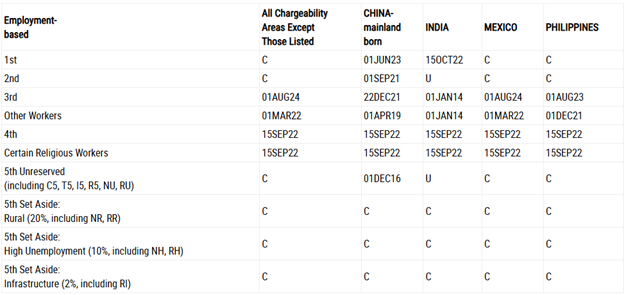
This table shows that, according to the July Visa Bulletin, all three EB‑5 set‑aside categories remain current for all countries, while unreserved EB‑5 numbers show constraints for at least China and India. EB‑5 investors from all other countries under “All Chargeability Areas” remain current even in the unreserved category.
July 2026 Visa Bulletin – EB‑5 Dates for Filing (Chart B)
The U.S. State Department also publishes a Dates for Filing chart, which can be used in some months to determine when applicants may submit their paperwork ahead of visa number availability. While USCIS has directed employment-based applicants to follow the Final Action Date chart for July 2026, the Dates for Filing chart still provides insight into how the State Department is managing demand.
Employment-Based Fifth Preference (EB‑5) – Dates for Filing (July 2026)
markdown
Table 2 – EB‑5 Dates for Filing (Chart B), July Visa Bulletin 2026
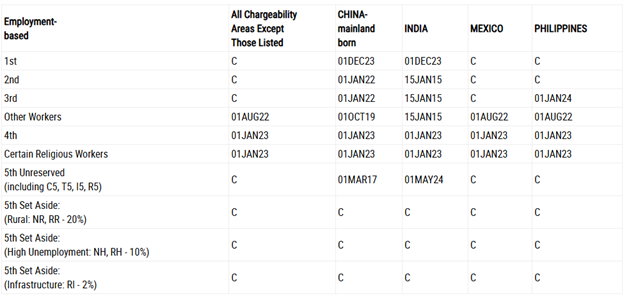
Although EB‑5 investors currently must follow the Final Action Dates chart for adjustment of status, the Dates for Filing chart can become especially important in future months if USCIS authorizes its use, allowing some EB‑5 investors to file earlier even if final approval must wait.
Summary of the July Visa Bulletin for EB‑5 Investors
Taken together, the July Visa Bulletin published by the U.S. State Department sends several clear messages to EB‑5 investors:
- EB‑5 set‑aside categories (rural, high unemployment, and infrastructure) remain current for all countries. For EB‑5 investors who prioritize faster visa availability, these reserved categories continue to offer a strategic advantage, especially investors from historically oversubscribed countries.
- Unreserved EB‑5 numbers face country‑specific pressure. In the July Visa Bulletin, India and China show cut‑off dates in the unreserved category, while “All Chargeability Areas,” Mexico, and the Philippines remain current. This underscores the importance of country of chargeability and project type when planning an EB‑5 strategy.
- The U.S. State Department and USCIS are relying on the Final Action Dates chart for July 2026 employment-based filings. EB‑5 investors inside the United States must monitor the Final Action Dates chart in the July Visa Bulletin to determine when they can file (and potentially receive approval of) adjustment of status applications.
- Policy incentives favor reserved EB‑5 investments. By keeping set‑aside categories current while unreserved categories experience more constraints, the July Visa Bulletin confirms that EB‑5 investors who choose qualifying rural and high unemployment projects are aligned with current statutory and policy preferences.
For EB‑5 investors worldwide, the July Visa Bulletin is both a status report and a planning roadmap. It reflects how the U.S. State Department is allocating limited immigrant visas and signals where queues may grow in the future. At Bedrock Group, we analyze each new July Visa Bulletin in detail to help EB‑5 investors understand how priority dates, country conditions, and reserved versus unreserved availability impact their personal immigration timelines. For investors who want to know exactly what this July Visa Bulletin means for their family, a tailored review of priority date, country of birth, and project category is essential before making or adjusting EB‑5 investment decisions.